PA 30 Twin Comanche Avionics upgrades Part 1
I own an N registered A PA 30 that is the poster child for over investment in capability and complexity. When purchased I was looking for an aircraft with long range capability and decent avionics. This aircraft had enjoyed a really major refurbishment then been based in the Pacific. It has a 158 USG fuel capacity plus permanent plumbing for a ferry tank. In theory it was state of the art circa 2009. In reality it was someone’s idiosyncratic vision of state of the art a decade prior to my purchase. Its most recent owner was a light the fires kick the tyres guy. Cosmetically it was in a poor state and I felt the asking price unreasonable. The owner was Swiss and had returned home from the Pacific. The aircraft was at Toussus le Noble near Paris. It had not been properly imported. The vendor took my point about the externals and had it resprayed and retrimmed. I then agreed to buy it. The importation was remarkably cheap. Given that the aircraft was essentially a pile of peeling miscellaneous bits when examined by the customs they accepted a very low valuation. They were also insistent it was an antique not an aircraft having been built in 1966 so it only attracted a very low rate of duty.
It had electronic ignition but this failed quite spectacularly during the long purchase process. The system was effectively abandoned by the manufacturer so the aircrafts vendor removed it and fitted four overhauled standard magnetos. He gave me the electronic system in bits and a box and left any future risk taking up to me.
To round out the picture the aircraft had the Robertson STOL system. This links the ailerons to the flaps amongst other serious modifications to give it real STOL capability. It came from the factory with the Rayjay manually controlled turbo option, had double puck brakes and lots of other modifications. Over 50 STCs in fact.
You will always be advised to get a survey when you purchase. In reality the typical physical survey is near useless. Most of the necessary information can be gained from the aircraft logs and paper work. Investigating these thoroughly is a time-consuming job for someone who understands what they should be seeing. Asking the best engineer to poke about, remove a few panels, do a compression check etc. is of very limited utility. If you really want reassurance go one step further and do an annual. If during the process you discover something really serious you can renegotiate or put the aircraft back together, pay your engineers bill and walk away. If the aircraft has serious avionics you also need an avionics engineer to give an opinion. They can probably work from photos and the aircraft documents.
In the real world its sometimes not easy to be as thorough as one would like. In reality, I did not fully take my own advice! I paid top money on the basis that everything worked. The test flight that was supposed to check all the knobs and switches did not happen as a mag failed as we taxied out.
In the end the aircraft was delivered and, inevitably, lots of things did not work. I have since spent three years and a lot of money fixing stuff and adding yet more stuff for reasons which I will, ever optimistic, attempt to justify as rational. However, I hope that an explanation of such thought process as there was and the ensuing hassles and minor disasters will inform, or at least amuse others. The underlying assumption is that the work is in the context of a fairly major upgrade with serious instrument flying in mind.
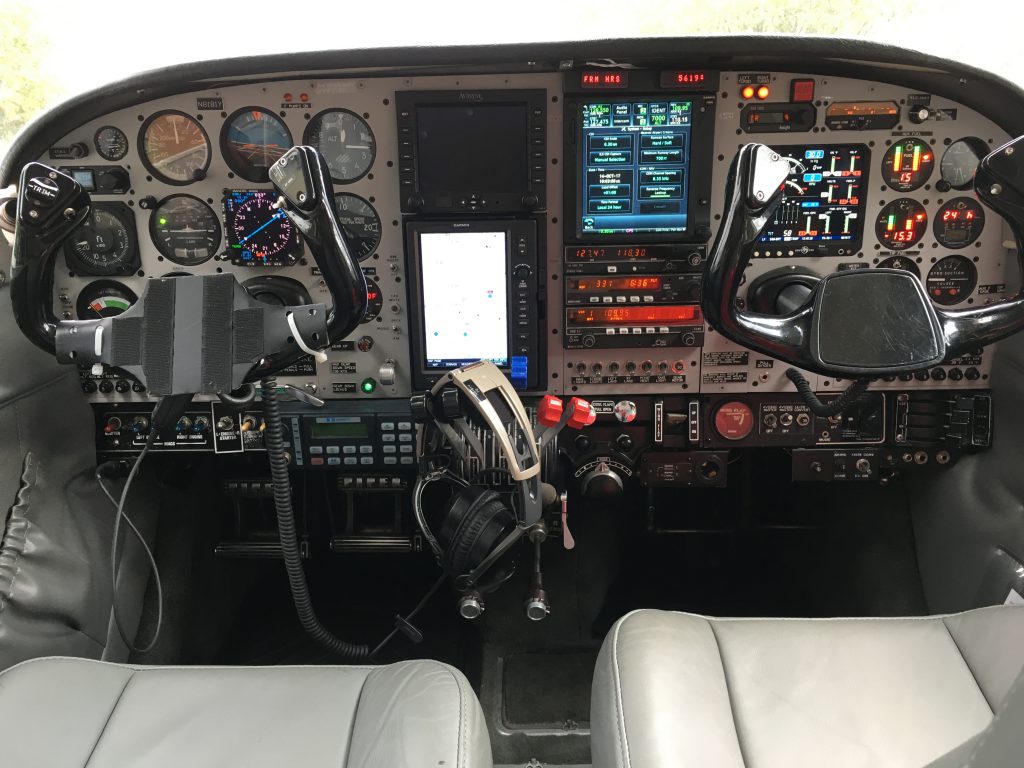
Here is the panel as purchased. Starting on the P1 side top left we have the SAM Steering Asist Module and the tiny windicator dial that displays windspeed and direction. This also provides GPSS steering which in effect spoofs the heading mode of the autopilot into following the flight plan. It can calculate hold entries and the like. Once you have had GPSS steering you would not be without it. Although it is now quite common, a decade ago it was rare. The SAM was an innovative retrofit that also offered air data style functionality. There was a vacuum AI and a Sandel HSI. The Turn coordinator houses an STEC 30 autopilot. The Radar Altimeter and a lift reserve indicator (LRI) sit nearby. Some of these can be seen more clearly in the larger picture
in the centre stack the main MFD was an Avidyne EX 600 below which is Garmin 696 portable in a panel dock integrated into the rest of the avionics. A single GTN 750, some King boxes. An HF system complete the visible avionics but remotely located are on board radar, storm scope. TCAS and two systems for data downlink. The EDM 960 provides all the engine data and there are various means of managing the complicated fuel flows and fuel quantities given there are 8 permanent tanks
The Radalt was a real oddball. It was made by Thales and said to come from an Exocet missile. It was live but did not work. There was zero documentation and no information whatsoever on the web. Perhaps it was top secret. In the end I could see no alternative other than to scrap it. The Garmin 696 was, in its way quite sensible. It provided lots of functions and had extended battery endurance. However, it was hard to use with a small joystick lurking behind the throttles. If I am really honest it just did not look right and that is why it had to go. It surprises me how pilots who will happily pay thousands of pounds extra for a top of the range car that looks good will make little effort to improve the look of their aircraft and are quite happy with a tangle of power cables to portable devices held in place by velcro and blue tack.
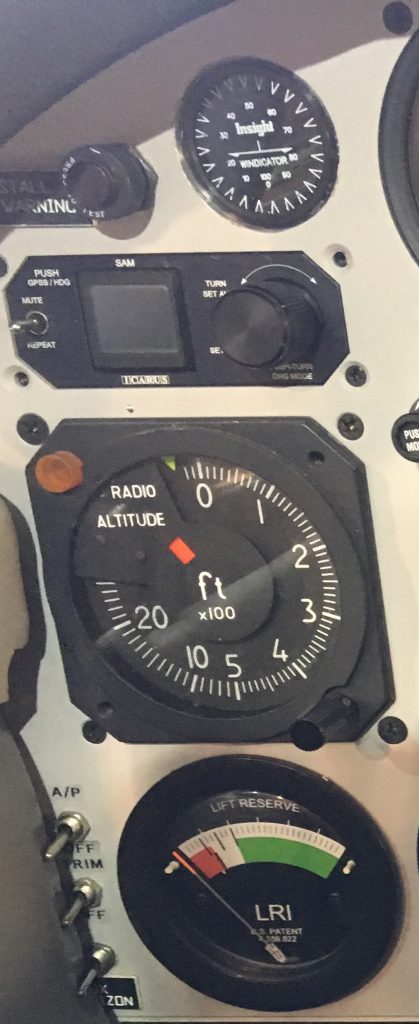
The LRI, lift reserve indicator is an entirely air driven device with its own pitot head under the wing. It’s the equivalent of an angle of attack indicator. I was interested in this is theory but having spent quite a lot of time calibrating it by adjusting the angle of the pitot head, hardly ever using it, then knocking it out of calibration it soon went on the ever expanding ‘scrap soon’ list. Again, if I am honest its demise was partly because it looked out of place and partly because I wanted the panel space for other things.
The SAM was extraordinarily clever and compact. It’s on/off button was also a tiny screen and this had failed. It was therefore a random prodding and twiddling exercise to discover which mode it had decided to operate in. The manufacturer had gone out of business so this device was also scheduled for the scrap pile.
You might think that a clock would be pretty basic but the first-generation Aerospace logic digital clock that nestled amongst the Aerospace logic fuel gauges had additional functionality but did not come with a manual. As it had been superseded, I could not obtain any data from the manufacturer or the web. In spite of hours of prodding buttons, I simply could not set it up. A computer savvy friend gave me pitying look on hearing this story. It’s just a clock for g.. sake. He came over to have a go. Two hours later he also gave up. Another one for the scrap list.
Matters came to head when one day, just popping into cloud after take-off, the AI toppled. I did actually know how to make the Sandel change from an HSI to its reversionary attitude indicator mode. I was congratulating myself on my forethought and competence when I discovered that its presentation was a sky pointer not the normal ground pointer. Let’s just say the circumstances were not conducive to adapting easily to this alternative presentation.
This instrument failure meant something had to be done and an electronic AI of some kind was the way to go. I was familiar with the Aspen and it fits into an existing panel hole so was the obvious replacement. The aircraft has a nicely installed aftermarket STC’d aluminium panel so I was not keen to hack huge holes in it for a Garmin PFD. The Aspen provided roll steering and wind information so the SAM and Windicator functions would no longer be needed.
The Sandel was an incredibly capable instrument for its time. It has a huge range of functions but is a little idiosyncratic and complicated with a very busy screen. In early versions display backlight failures were common but this later model had no such issues. It had its own AHARS unit to provide the standby attitude indicator. This was a very pricy extra so well worth keeping. I had owned an Avidyne EX 600 MFD in another aircraft. Although, at the best of times its screen is a bit dim, it was excellent in its day. It controlled the on-board radar and the Avidyne colour stormscope. These functions cannot easily be taken over by the GTN 750 so I aimed to keep it. I wanted a backup GPS/Com. I initially considered the GTN 650 but the price differential with the 750 was not that great in context of the planned spend. Having established that everything could fit I decided on a second GTN 750. Assumptions as to panel space need very careful consideration. It’s not just the real estate in the panel but also the depth available behind the panel. You can only find this out by removing whatever is already there.
The existing GTN 750 controlled the remote transponder and a remote audio panel. This meant that a lot of the time that screen was unavailable for navigation displays. Partly for this reason and partly to be ADSB future proofed I decided on a second transponder, a GTX 345 with ADSB in and out to be located in the avionics stack and directly controlled.
I think it is fair to say that the aircraft, as purchased, looked well and avionics wise appeared to have been professionally retrofitted. A wiring diagram is an obligatory part of many STC modification and detail records of configuration settings should also be in the paperwork. This rarely happens in practice and this was the case with 81Y. I tracked down the US avionics company responsible for the bulk of the work and offered to buy their file paperwork but they refused to even respond to Emails. This then led to considerable expense as my engineers spent frustrating days tracing and recording the existing wiring and configurations.
A large quantity of very disorganised paperwork came with the aircraft. It was unclear what equipment had flight manual supplements and to what extent the modifications had been logged with the FAA. The FAA offer an excellent service and will send you the complete records of any aircraft on a DVD for $10. That gave me a starting point and 4 or 5-days’ work was needed to get the mass of paper in some degree of order and ensure a reasonable degree of compliance. In the words of Donald Rumsfeld, we have moved from mostly unknowns to mostly known unknowns.
So, the major upgrade had been decided upon. I knew from past experience that any idea of multiple quotes or haggling on price would be a nonstarter. There are probably only three really competent avionics shops in the UK and they are all extremely busy. I approached the avionics shop I had used for many years. They were, as I expected fully committed. Their staff were constantly being poached by the airlines as soon as they were fully trained. The only slot they could offer was 6 months in the future. This was more delay than I could stomach given the lack of an AI so I looked elsewhere. With the benefit of hind sight I should have grabbed this local time slot with both hands. Instead, encourage by recommendations from friends, I opted to send the aircraft to a shop in the Channel Islands. The hardware had been ordered through them and paid for so I became fully committed and had to accept several delayed start dates. Having got the aircraft to the CI I discovered that their avionics expertise rested in a single young man. He was technically quite good but overworked with little or no backup. In the event he was poached by the airlines while my much-delayed install was in process.
The plan had been to install a second GTN 750, the Aspen, a GTX 345 transponder and relocate or remove existing boxes as appropriate. The engineer would not have time to finish my aircraft before he left and there was no plan B. He was willing to complete part of the work and since I had to have an AI of some kind, we agreed on a Garmin G5 which was not part of the original plan. Apparently, this was a much simpler job than the Aspen. I did not quite understand the logic but by this stage I was desperate to have an aircraft I could fly away from the Channel Islands. You may save the VAT in the CI but you are pretty much a prisoner once your aircraft is there and in bits!
I collected the aircraft and discovered, once airborne, that the reason the G5 was less installation work was that it was not connected to the pitot system or indeed much else. Neither had it been set up. Fortunately, I kept to my rule of never flying an aircraft that’s just had maintenance in anything other than good VMC. I also discovered that the G5 approval was limited in bizarre ways. (this has since been changed). Mercifully the exact detail has faded from memory but it related to its use in the primary or secondary roles. I got round this by involving three different shops with fitting and setting up the G5 so they could all credibly claim it was the other one that had done the illegal bits.
The aircraft eventually ended up in my regular avionics shop months later than the slot I had at first rejected. They had agreed that in the interim my airframe engineers could physically install the Aspen in the panel and connect it to the pitot system so some progress was made during the delay. This is an N registered aircraft and any A&P can legally install avionics. However just like Clint Eastwood a man has got to know his limitations and Rob at Aerotech at Coventry knows his and avoids complicated avionics.
I thought that I was now in the final phase of the upgrade process. Perhaps the fact that a further two instalments will be needed to conclude the story hints at the extent of my over optimism