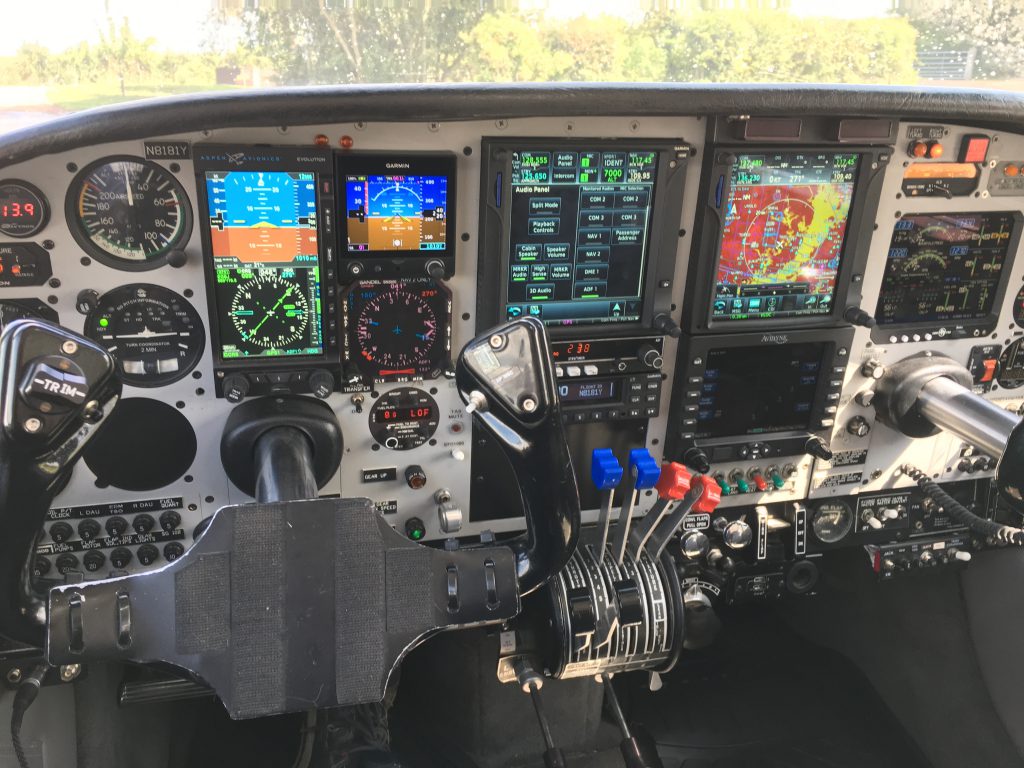
We left the story of the N 8181Y back at the local avionics shop almost 12 months after the project started. The aircraft emerged with the layout you see above. It’s not quite as tidy as I would have liked but having a G5 and a Sandel, even my propensity to throw money at the panel could not justify a second Aspen to displace a working G5 and Sandel just for visual appeal. I find the layout quite functional. It may even be mostly legal. There are still some outstanding paperwork issues but it appears that the FAA no longer actually audit the Form 337s as they once did so there is no reason to panic. With me doing the administration, a lot of cooperation from the engineers and some owner maintenance log book entries the aircraft is on the way to having compliant paperwork. It started with 50 plus mods, we have removed 6 or 7 but somehow the total has crept up to about 58. Possibly something of a record.
I now have three electronic AIs, two with battery backup and three HSI’s. There are three altimeters since there was a traditional altimeter and a spare hole (invisible behind the yoke) available. The three nav screens include the original EX 600 which has been relegated to the bottom of the right-hand stack. Below the No 1 GTN 750 there is a KR 87 ADF that displays on both Aspen and the Sandel. Below that is the GTX 345 transponder which feeds traffic and data to an iPad via Bluetooth. I take the view that, for the long distance flying that interests me, a second transponder is a plus. No transponder no airways clearance 1000 NM from home is not fun.
The two GTNs will not cross feed because of the differences in their configuration. I know a lot of pilots like cross feed but I don’t. I take the view that there is not that much to do in the cruise and entering the flight plan into the second box is no big chore and keeps you aware of your planned routing. For the same reason I have no desire to autoload a flight plan from my iPad.
It seems to me that getting a route from say Rocket Route, downloading to the iPad then loading it electronically onto one or two GTN750 means you have minimal real sense of where you expect to be routed.
One thing to be very aware of it that Garmin charge a lot for an unlock card for additional functions such as radar or approach plates. I had to purchase the approach plate unlock for one GTN. Garmin support is very good but not perfect. The original GTN 750 went back to them to fix a fault and they did not reconfigure the approach plates option. At first, I could not find the unlock a card and Garmin proposed to charge me again for a function they had themselves disabled. In the end the card came to light. Be very sure that the tiny SD card is somewhere safe so you can find it, maybe several years in the future.
As you can see there remains a reasonable amount of space in the stack which could be a home for an autopilot upgrade. The previous owner had a thing about complexity in rate-based autopilots so he opted for the STEC 30. In essence this only works in level flight and has trim prompting. Left to myself I would have fitted the STEC 55X or kept the old Piper autopilot assuming it was working or could be made to work and just added GPSS. There is no good value upgrade route through STEC for the 30. Given that very cheap digital autopilots are slowly becoming available I feel that STECs keeping pricing high for its pre digital technology is unwise. I would not invest in their shares. I don’t personally want the full bells and whistles of coupled approaches but I would like the ability to climb and descend on autopilot. Trim prompting is better than one might think but I would pay a modest premium for auto trim. If you have not come across a prompting system when the autopilot senses too great a control load an audible and visual alert tells you in which direction to apply trim. In reality, once settled in the cruise demands on the pilot are minimal. A yaw damper, TOGA or an emergency wings level blue buttons strike me as superfluous on this class of aircraft.
Returning to N8181Y you might think that was the end of the story but far from it. It took an age to get most of the avionics to work and talk to each other. It is really difficult to explore the full functionality of a complex avionics fit without flying the aircraft quite a lot. In spite of much factory tech support we never did persuade the Sandel that it was talking to GTN 2 and simply had to put a sticker over the annunciation that insisted it was talking to box 1. The GTX 345 is a very complicated piece of kit which provides Bluetooth to the iPad and integrates the two sources of traffic information. We were on the third new box (all provided under warranty) before we got one that actually worked as promised.
I have a permanently installed Golze downlink and this displays nicely on the iPad using Foreflight. It is ridiculous with this many screens in the cockpit I cannot have a panel mounted display with a decent VFR chart but that seems to be the situation in the certified world. As the yokes are a modification from a Piper turbine aircraft, they are quite large and I made up a tidy mount that fits an iPad Air inside the yoke. This works well.
You cannot have too many auxiliary power sockets. I lie you can. I have 2 cigar lighters and 6 USB points scattered about for reasons related to the evolving upgrades to the aircraft.
The RDR 2200 radar had been intermittent from day one and still was. Annoyingly it always worked when the avionics techs were looking. Eventually we discovered that it was the 12/24-volt converter causing the problem. The radar and the Avidyne only work on 24 volts and the aircraft has a 12-volt system. The manufacturers of the convertor had gone bust and another manufactures unit did not fit in the same physical space but in the end, this was resolved. It’s rare to have radar in this class of aircraft. Having had it before in a Cessna 421, it is something that you don’t use often but when you do need it its very valuable indeed.
The Avidyne TWX 670 colour stormscope is quite sophisticated and can only be tested with a special box that no one has. The old wandering round with an electric drill creating sparks test that is Ok for a standard stormscope does not work. In the end we borrowed a test box and showed that the TWX 670 works in its test mode but I remain unconvinced about its real-world performance. It has an audio warning function. From time to time it whispers in a hoarse threatening voice, reminiscent of a horror movie ‘lightening at 12 o’clock’ or something similar. This warning has seemed to reasonably match the real weather a couple of times but four years on this is still a work in progress.
The best advice I can give you about Avidyne products is don’t buy them. If you simply must live dangerously at least buy the extended warranty. This aircraft as purchased had two different Avidyne downlink boxes both of which had their data service withdrawn. I became the possessor of $20ks worth of scrap without even an apology. The EX 600 started to fade away. On any chilly morning it would take 10 minutes for the screen to be visible at all. It emerged that Avidyne had outsourced support for this unit to Duncan Aviation in the USA. Eventually I tracked down a man who admitted he fixed them. I sent the box over and the first response was it was within specifications. I pushed back and they cold soaked the box overnight. Hey presto it did what I described. They tested several other boxes they had on the shelves and they did the same. They then spoke to Avidyne. It emerged this was a known fault in some electronics that drive the screen. This component was no longer available so a new super bright screen was needed at a cost of a mere $6000, not the fixed fee repair of circa $2000 I had been promised. My first reaction was to ditch the box. After a little research it emerged that to make a GTN 750 display the radar and Stormscope would have cost even more in rewiring and unlock cards so in the end I paid up.
The issue of avionics spares and redundancy will I think affect many owners in the in the future. The EDM 960 engine analyser also became awkward and would not display any data at night. We discovered this in an unforeseen night approach into Kuwait. Try flying a twin at night with no engine data whatsoever. As it happened, we were two crew so I could fiddle with the throttles from the right seat while an experienced colleague, albeit with minimal time in type wrestled it to the ground. In the meantime, I also dealt with ATC insisting we were a helicopter and then trying hard to persuade us that we did not really want to land at Kuwait International. This was unwelcome since I believed this was the only airfield of entry in the country and we had nowhere else to go. It emerged that the EDM also needed a new screen. This came at a far more reasonable price of under $1000 but there was a sting in the tail. The screen fitted the same panel cut out but was very slightly bigger behind the panel. For most aircraft this would be a non-event but this panel is pretty packed. It fitted, but only just!
I hate having too many holes or blanking plates in the panel. This meant I had a few odd shaped and standard sized holes to utilise. This led to me install yet another a standalone OAT gauge and a voltmeter that comes as one-inch circular instrument to replace the hole left by the odd sized windicator. Having three OAT readings has cured me of any expectation that the indicated OAT is very accurate. Readings differ quite considerably. I have spent some time with ice packs, hot air guns and an infra-red thermometer trying to figure out which one is accurate but what happens on the ground seems different to what happens in the air.
I try and be insistent about removing old wiring and redundant mounting hardware but I have often had to give up. There are avionics bays behind the aft bulkhead and in the nose. Main looms thus snake their way under the floor to the panel. They bundle dozens sometimes hundreds of wires clipped and ty wrapped in many places. There is really no way to trace wires and pull back redundant wires. I am guessing that if the aircraft was completely stripped down for annual five or six days work for one competent guy would be needed to really get rid of the redundant material. If you see the strip down needed for an install of this magnitude you will be appalled. Even with this degree of disassembly much old wiring just has to be left alone. It makes sense to combine an avionics upgrade with the annual but often, as in this case the logistics do not work out.
Having had time on my hands during the lockdown I counted how many pages of major avionics manuals were now on my iPad – 2000 pages is the answer. That is just the pilot material it doesn’t include the install manuals. It’s a heck of lot to get to grips with.
All this equipment draws lots of power and that is without using HF radio or putting on the lights. The aircraft emerged from the factory in the 1960s with generators. Decades ago, 50 Amp alternators were fitted under an STC. The latest avionics set up draws over 50 amps. The avionics shop had to buy an upgraded ground power unit having been surprised to find it was flattening the aircraft battery while using their standard ground power supply. I have fitted 70-amp alternators so even an engine failure will not involve load shedding.
What general conclusions might one draw from this experience. There is not the slightest chance of getting back the money invested in a major avionics refit on sale. If you can buy an aircraft that has near to the fit you desire then you would be better off changing aircraft and letting someone else take the pain. I am sure that the modification spend on my aircraft with be two to three times any likely eventual sale value. On the other hand, I will end up with an aircraft that is configured in just the way I want. A new or nearly new aircraft will depreciate considerably over two or three years and will probably represent a loss of similar magnitude even if you discount needing five to 10 times the initial capital outlay. Sadly, in some ways, the performance of this 50-year-old twin betters pretty well any piston engine aircraft that it could reasonably be compared with.
Don’t be persuaded that any major install will go to plan. You need an avionics engineer who really understands the systems but even with this input there will still be surprises. This might be less critical if one was installing an entirely new Garmin stack but if one is integrating multiple brands across multiple generations of technology the task of getting them to talk properly to each other is bound to be demanding.
I would be very wary of buying any used equipment or buying new equipment other than though the dealer doing the install. The pitfalls are many. Additional sub units may be needed to integrate with different manufactures and some units, available at what seems a low price turn out to be uncertified. I once bought a very low hour G1000 C182 only to discover later that it was non WAAS and the upgrade would cost over £20k. I sold the aircraft.
Lest this difficulty all be put down to new technology I have been struggling for over a year with the venerable King KR 87 ADF. I have swopped out the antenna and the box to eliminate them and had some work done on the housing. Most recently I have replaced the cable that, and I quote ‘never goes wrong’. This took me into the realms of questionable legality of having one made up by an approved shop rather than buying one from King bundled with an antenna I did not need, at a cost of several thousand dollars. By this stage I would make a sacrifice to the god of avionics if I knew who he or she was if I thought it would resolve this issue.
One good thing about a major upgrade is that rarely seen parts of the aircraft can be examined. the photo shows the haul of junk from the area around the P1 footwell.
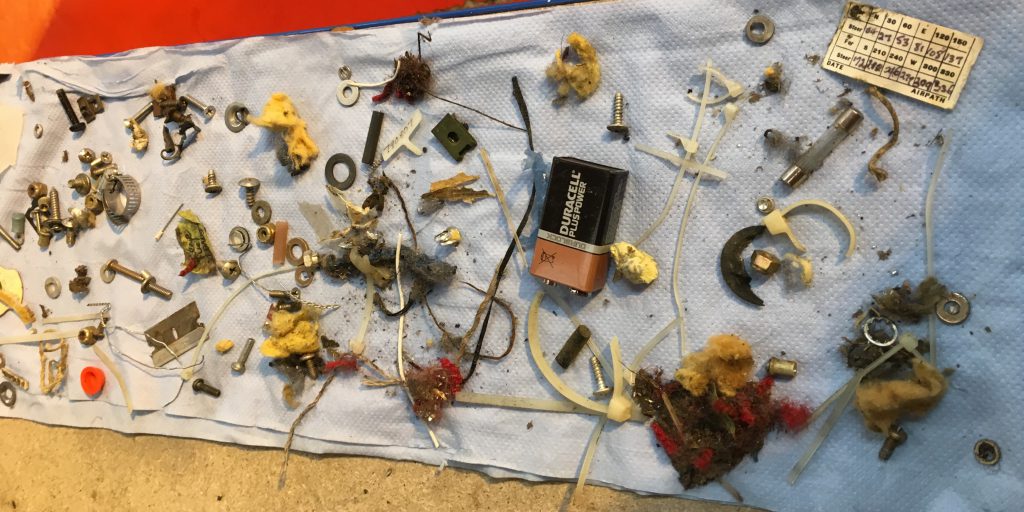
These floor panels should come out at every annual to examine and lubricate control cables but obviously not everyone bothers. I refurbished and resprayed all my floor panels and took the opportunity to remove lots of rotting fibreglass and replace it with new insulation.
This concludes the second phase of the saga. The aircraft was working well enough for me to leave to fly to Australia early in 2019. This trip was not without incident. There was a serious medical emergency diversion and the Pakistani Airforce shot down an Indian jet literally as we were airborne about to enter Indian Airspace. Clearance was refused unless we could climb to FL350 so we diverted back to Karachi. Pakistan airspace then closed and after being held for some days the only option was to retrace out steps back home writing up a new list of snags along the way. My immediate reaction was to think I should have just followed our flight plan and blagged our way into Indian airspace. I think this would have worked but with hindsight, given the subsequent pandemic and lockdowns the aircraft and perhaps its crew might have ended stuck somewhere undesirable for a very long time.