Avionics Upgrades Part 3 V2vw Oct 20
Back from the abortive trip to Australia, by January 2020 it was time for the annual. It had taken me several years to move the annual date to the depths of winter. As I write, in early June I have just flown the aircraft home after 5 months so moving the date of annual will have to start again.
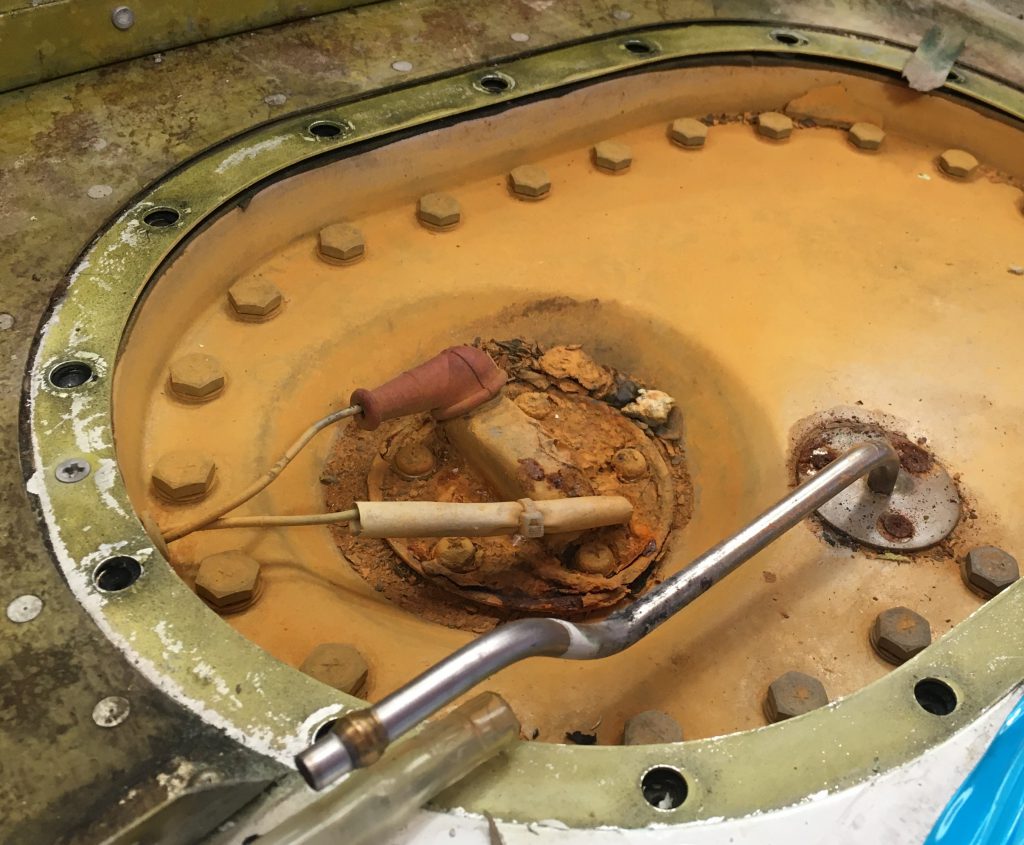
Of course, no one could forecast the lock down but I had already set myself up for difficulty with more modifications. Most of these were not exactly avionics but the boundaries between avionics and instrumentation is getting a little blurred. I decided to go for electronic ignition and completely replace the fuel level measuring and indicating systems. This brought another maintenance issue to light. it emerged I had been flying a small swimming pool for some time. You could actually crumble the existing fuel senders with your fingers. This was perhaps a forgivable maintenance oversight as to get at the auxiliary wing tanks you need to remove the nacelle skins and the nacelle fuel tanks. There is no regular maintenance action that makes this area visible.
Extended warranties never seem worth the money till something breaks. Avionics repairs are never cheap but they can be eye watering. Garmin Gx30 series nav coms and similar avionics are well over a decade old and cannot fit the current bloated databases that are now the norm. Really the G430 /G530, amazing as that may seem, is not a box you would now install for serious IF. Data cost is something you will need to think about. I pay a lot to cover the two GTN 750s and the iPad but I don’t update the data bases in the Aspen or the EX 600. The Aspen has the synthetic vision option which I don’t personally find useful but I think that may stop working once its data base is very old.
Avionics optional extras can catch you out. I was offered the angle of attack (A of A) indicator for the Aspen at a low price and had almost said yes when my excellent avionics engineer sent me the calibration procedure. Its complex and I concluded that with my heavily modified aircraft I would never succeed in calibrating it so opted out. I once spent some quite enjoyable time flying a Cessna Conquest on A of A calibrations flights for a standalone instrument. We were puzzled by our complete lack of success till it emerged that the sensor had been installed upside down.
Be clear you must spend quality time with the pilot’s manuals and ideally the install manual for the avionics. Some of the failure modes and operating characteristics can have quite serious outcomes. The first-generation Aspens need airspeed for the attitude calculation. If you forget to switch on the pitot heat and it ices up everything will red X. You may recall from the first of these articles that the upgrades were in part prompted by the failure of a vacuum AI. Electronic AIs have the same failure potential as the old vacuum instruments. You need to know how to switch it off and refer to a backup or you will become disoriented in seconds. Once you are sure you can keep blue side up you need to know what will still work. The autopilot may or may not function but some effects can be surprising. In another aircraft the Aspen AI inverted in a micro second and then tried to imitate a 1970s lava lamp on steroids. There were probably only a few seconds in which to switch it off before seriously disorientated became inevitable. This aircraft was fitted with an adjacent backup AI so that was fine but the King autopilot was dead. (In the PA 30 the rate based STEC would have worked but minus the heading bug). The GTN knew where it was and where I wanted to go but without a heading input it did not know which way the aircraft was pointing. It is surprisingly distracting for the little aircraft on the screen to follow the flight plan going sideways.
Here is the final result for N 8181Y. Maybe final is too strong, shall we say the latest state of play.
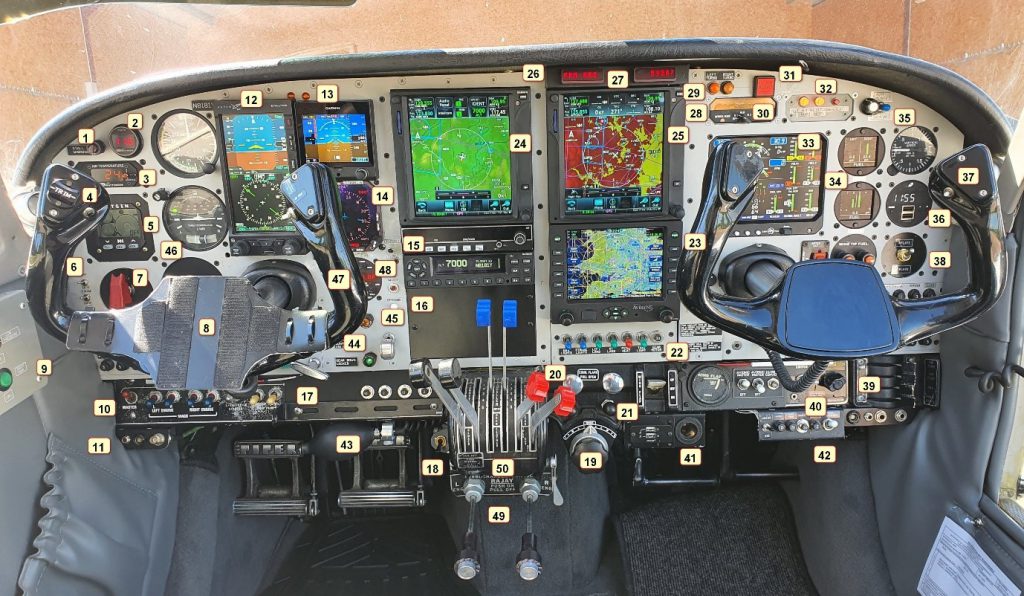
I had previously replaced the Oxygen system with a modern low pressure programable set up with pulse delivery. At the time there was no panel space for the control head but I now wanted to move this into the P1 panel (5) and to move the distributors to convenient points on the side walls so as to minimise the length of tangled O2 tubes. Over the lockdown I have remade or repaired all the interior panels, removed 50 years of old glue and retrimmed them with an approved Airtex trim kit. This has kept me sane and my wife happy as I have been out of the house and in my hangar most days. I have replaced most of the interior lighting with LEDs and remade one or two switch panels. Another three-year battle has been to pin down the sources of cold drafts and make the temperamental near new combustion heater work. I am not sure we will ever fully beat the heater. Normally it draws air through a round hole at the tip of the nose cone. Since the nose now houses radar, air enters via a Naca slit below the nose. I have no way of proving this but I suspect that the flow on the ground or at low airspeeds is not adequate so there tends to be an overheat. I have fitted an overheat light (32) on the panel and the reset is automatic so this can now at least be managed by only having low heat settings till the aircraft is in the cruise. For those who have not flown twins an inability to clear the screen on the ground can be a no-go item. There is no propwash to clear rain so if you add condensation you can sometimes see next to nothing.
I opted for inflatable door seals (43) so I have some hopes one draft has been eliminated. Even the stone simple manually inflated seals arrived with a brass on off pneumatic switch (38) that leaked and needed to be replaced. I was looking forward to seeing if the fuel gauges (34) really are accurate to less than one USG and that I get something approaching the 2 USG fuel consumption reduction that the electronic ignition kits promised. I will also appreciate instant starts. No more embarrassment at the fuel pumps with vapour lock on hot days. Both these systems are, surprise surprise proving challenging to get sorted. They may warrant specific articles if and when I am convinced they are working as advertised. The new screens on the EX 600 and the EDM 960 are indeed very bright. Obviously £6000 well spent.
The door with its new seal proved an impressive safety feature. I could not get it closed without outside assistance to lock me in so could rarely fly. It’s almost as safe as my old B36 where the electric primer took to firing the windscreen TKS thus making it impossible to taxy.
There are various electrical anomalies and the Oxygen system, having been disturbed is leaking. In ancient times every annual required a test flight by a CAA approved pilot. I flew quite a few of these tests. Owners objected to the expense and the risk of the manufacturer’s performance numbers being written down and entered in the flight manual thus devaluing the aircraft. The CAA had a full-time light aircraft test pilot and I flew with him to get the approval. He was a graduate of the famous Empire Test Pilots School and it was a masterclass in the operation of every switch and system in the aircraft in the absolute minimum flight time. The test concluded with the VNE dive. I don’t miss having to do those wondering if some ancient antenna or worse would detach. The flight test system had value in that after an annual either everything worked or it was placarded INOP. This is rarely the case now.
Calibrating the fuel gauges is an incredibly time-consuming task adding 2 USG at a time and recording the sender output. I built a defueling rig with a 50 USG stainless steel drum some time ago. Even so it means finding lots of one or two gallon containers that are not too much of a fire hazard. I cocked up my first calibration attempt completely and have some sympathy for the engineers who had previously managed to get it wrong on all 6 tanks. The manufacturers install instructions were written by someone who trained writing assembly instructions for flat pack furniture. You might think this level of attention to detailed calibration is over the top in an aircraft carrying 158 USG. Last year, having been evicted from Pakistan as mentioned in Part 2 we ended up having to fly Karachi to Al Ain with a head wind that at one point reduced our groundspeed to below 90 knots. The only realistic diversion was to turn back which, having been stuck in Karachi for three days with war seeming likely, was less than appealing. Really knowing how much fuel there was in each of the 6 gauged tanks would have been a great reassurance.
Being a sad geek I calculated how many pilot programmable data boxes were available between the two GTN 750s. There are least 14. The basics of bearing, distance, groundspeed, track are available all over the place between the Garmins, the Aspen, the G5 and the EX 600. That’s ignoring all the data the transponder is feeding to Foreflight on the iPad.
When I started flying IFR the problem was the paucity of data. From quite limited information you had to build a 3 D picture in your mind of where you were and where you were likely to end up. Now we have data overload and the problem is one of managing data. Pilots seem to find this just as difficult judging by the number of times I have watched candidates baffled by bizarre indications arising from buttonology failures. I have had my own moments of being button challenged, sometimes thanks to innovative students, sometimes self-inflicted. I hope the difference is that my core training and experience means that going back to basics and flying the b..y aircraft saves the day.
The important thing is to give a lot of thought to procedures that work for you with the kit you have in the aircraft. It is very unlikely your initial training will have helped much and IR holders who take voluntary refresher training are vanishingly rare. My general strategy has been to disable as much peripheral functionality as possible across the board. Then I keep the prime nav screen as decluttered as possible. All the secondary stuff like terrain, traffic and weather are displayed elsewhere. There are considerations as to the best way to back up approaches, the degree to which the autopilot and auto switching between GPS and VLOC is desirable. There is plenty of room for different opinions on best practice but it’s quite clear to me that many pilots have no consistent strategy. This may work out in benign conditions but it risks serious errors when under pressure.
You might reasonably think there is nothing else I could possibly add to this aircraft. I suppose I am an inveterate fiddler and I am quite interested in the new super lightweight lithium iron aircraft batteries! It is rather ironic that having arguably created the most capable long-distance touring piston light twin the world there is nowhere to go. It has 11 hours endurance, many duplicated systems, every form of weather, traffic and navigation information available, HF and sat phone communication, huge O2 endurance etc. AVGAS is as cheap as it has been for years. Unfortunately, it’s illegal or impractical to land outside the UK just now and it may be a long time before long-distance travel is practical and enjoyable again.
I will just have to continue working towards my lifetime ambition of owning a light aircraft where everything and I mean everything works. A week, a day or even a single short flight would be enough for me. We all should have dreams.