An Airstrip of your Own
I think that many pilots will have landed at some idyllic farm strip and imagined how great it would be to have one of their own. I had certainly done this. Circumstances conspired to make me a partner in a consortium who bid for number of farms being sold by the Prudential Insurance company. In the way of large organisation, they had gone through a phase of buying farms, manging them rather poorly and then deciding on a change of strategy. Naturally they placed the sale in the hands of a large London Estate Agency. Their representative was a person of an upper-class style even then rather out of his time. He became known to us as ‘red braces’ for obvious reasons. He treated us rather disdainfully obviously thinking we were the rather thick country cousins. We were quite happy to chew grass and seem bemused as he obviously had little idea of the value of what he was selling.
We were an informal consortium of friends who together managed to persuade the bank we knew what we were doing. I and one other person were interested in property development, another was a farmer at heart and for the fourth it was simply a speculative investment. The property on offer was quite complicated with several farms and quite a lot of land, about 1000 acres in total. I like to think it says something about us all that through several years of complications and without anything at all written on paper the project was completed and we all remain friends.
1000 acres. Surely an airstrip must be possible. As it happens the farmer partner was also a pilot so developing an airstrip crept from being a dream to became a prime objective.
The first thing to say is that it is amazingly difficult to carve out the modest piece of land an 800-meter runway requires. In an ideal world the land would be flat orientated to the SW or West. There should be no neighbours to annoy and no obstacles at either end of the airstrip. Finally, in an ideal world, there should be a building to house the aircraft and it should be within walking distance of where you live.
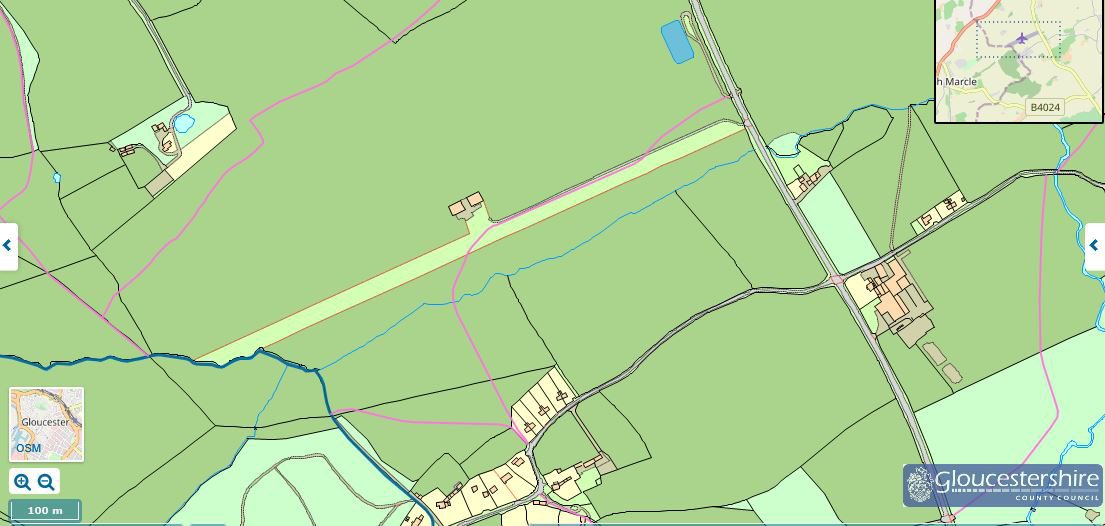
I was intending to move into one of the houses, more for tax reasons than because I saw this as a long-term home. Steve, the farmer and I looked at detail maps and walked the land. There was one large flat field that might have served but it was perhaps mile for both our homes and had no buildings. In the end we opted for an 800 metre strip 22/04 that stretched between my current residence and Staves cottage. The bad news was that it had a 4% slope, had buildings at the 22 end and high voltage lines just beyond the 04 end.
I suppose the take away here is its surprisingly hard to find an area of land that works as a strip and this may involve compromises on the list of ideal qualities.
Did I mention that there was a hedge across the middle of the selected field(s). This was in the late 1980s so we just grubbed it out and roughly levelled the land. Conserving hedgerows was not a big thing at the time. Defensively I might mention that since that time I have planted hundreds of meters of hedgerows and lots of tress so I don’t feel all that guilty.
As well as the slope along its length the strip had a slight cross slope and plenty of humps and bumps. We did a certain amount of levelling the worst of the bumps but really, we just wanted to get flying. With the wonderful clarity of 20/20 hindsight, we should have ploughed and levelled the whole field. Put in drainage and reseeded it with slow growing grass and accepted a year’s delay till it was usable.
We did not really concern ourselves with planning permission. It’s still just a field ain’t it governor.
This cavalier attitude stemmed in part from my background working running children’s activity holiday companies. There was, and still is, a 28 day rule. you can do more or less anything legal on land for 28 days a year. I the summer months we used to erect tented villages that accommodated several hundred kids and by the time the locals had objected and the ponderous planning enforcement machinery had got started especially given it was the holiday season we had cleared away the site so there was nothing to object to.
I do not necessarily recommend this cavalier attitude today. Certainly, if you want your airstrip to have value it will need to be legitimate. Then if you start using farm buildings to store an aircraft that is perhaps more likely to lead to you falling foul of the planning regulations as its rather harder to hide but read on.
Neighbours
The main source of difficulties is likely to be neighbours. Time spent informing them and reassuring them will not be wasted. They inevitably think its going to be like Heathrow while the reality is that most strips with on based aircraft will scarcely generate one movement a week. In my 30 years of ownership I have only had one query, it could not really be called a complaint. One fairly distant neighbour who had returned from administering the colonies felt sure their must be a regulation involved. He approached the parish council chairman. I had been there before him with explanations, offers of hosting the village fete and a modest contribution to the church upkeep fund.
Simply being told by someone in (very limited) authority that it was Ok was good enough for him. I was invited round to drink sherry and be interrogated as to my social background.
As I say I have never had a single complaint but I do make an effort. it only takes single aggressive newcomer to cause real difficulty. I don’t allow beat ups or circuits. At one time I allowed a couple of aircraft to be based on the strip. One pilot flew in a manner designed to alarm the locals and was asked to leave
Sharing a Strip
It may well be that a degree of sharing is necessary to make the finances work but a very clear agreement needs to be in place. At a later stage the strip came into my sole ownership and I allowed a friend to base an aircraft there. He was perfectly responsible but inevitably from time to time his aircraft was in front of mine in the hangar and the irritation factor became too much. I have never charged anyone for using the strip. It is now on Sky demon and visitors are welcome with PPR but I would be reluctant to share hangarage. Any income generated would not be enough to compensate for inevitable tarnishing of what is after all a dream.
Maintaining a strip
I guess that the field that includes the strip is about 15 acres. if you mow the whole thing it’s a lot of work and very wasteful. The easiest thing to do is to agree with a local farmer that they can have it for hay or silage. I have also tried sheep. Sheep are absolutely expert at getting themselves killed and doing irritating things. Even with the most careful management and electric fences they walk in single file and inevitably put muddy grooves into your carefully tended grass. Secondly sheep shit has impressive glue-like qualities and is hard to remove from aircraft aluminium. Even getting a third party to make hay has its moments. If they have big tractors, they can make a mess of the runway surface. My strip as a hump so taking off from 04 you cannot see the 22 end. Taking off over the hump to be faced with a large tractor spoils your day even if destruction is averted. Then getting a farmer to be cautious about where he drops his bales is hard. I swung a taildragger round at the edge of the strip, misjudged or forgot a small stack of bales and did significant damage to the tailplane. This accident taught me a valuable lesson. Getting out of the aircraft there was not a single mark on the tail surfaces of the Cessna 185. Not long before someone had done something similar with a robin at Kemble, they then took off and the wing separated killing them. I arranged for an engineer to some out with a borescope. Sit emerged that two ribs had deformed internally but the skin l had oil canned back into shape.
I eventually reached an agreement with a local farmer who understood the issues and got use of the field free as long as he realised that flying imperatives took precedence over faming priorities.
I mow the actual strip myself and in general can forget about the rest of the field. It is worth mentioning that once crops start to brush the wing, they can be dangerous. Grass is not usually heavy enough to grab the wing. I have friend who took off at dusk and allowed a wing to catch the corn crop and this wrote off his aircraft. Even hay will make a mess of your leading edge and may end up blocking the pitot tube so you need to be aware of this in the weeks when the grass is long but not quite mature enough to cut.
Mowing an Airstrip
I now use three different tractors but then perhaps I have become a tractor geek. I have a 35 HP tractor with a topping mower and rollers. This has rotary blades. Flails are a bit crude and cylinder mowers as used on cricket grounds and the like need maintenance and do not take kindly to stones or molehills. The only negative to this mower is it is supposed to run in straight lines. Turing without raising the deck puts a strain on the roller bearings. They will take this abuse if it’s done slowly but its less than ideal and eventually the roller bearings fail. Of course, most of the strip is straight but there are turning circles at each end and in the middle.
I also have what’s known as a batwing. This mower has a deck in front and one at each side that lift hydraulically. You will see the council using them to mow verges, roundabouts and the like. They get a lot of abuse. I bought mine very second hand many years ago. It’s still going strong and given very little trouble give or take a few burst hydraulic pipes and a new seat.
I also have to maintain a fair bit of garden and an orchard. Picking up grass is a nuisance and not necessary as long as you mow often enough for the cuttings to be small so they soon rot down.
To deal with this I have a diesel lawn tractor with what is known as a collector with a high lift. This means that you can collect grass cuttings and dump them on a heap without getting out of the tractor seat.
This is not generally relevant to the airstrip but just occasionally I fall behind on keeping the strip’s grass short and end up with a lot of cuttings that are unsightly and may never rot down in any reasonable timescale. I therefore occasionally have to hoover up the cuttings. The machine does the job well but the quantity of grass means that the collectors is filled several times and driving to a suitbale dumping area is a pain.
All weather use
The strip got boggy after periods of heavy rain. It was rarely impossible to use it but there was an element of risk and the need to wash a very muddy aircraft is disincentive to short pleasure flights. In winter taking off early in the morning after a hard frost was sometimes the answer.
At the outset I think it would d have been possible to put in afield drainage system that would have done the job and kept the field usable all year. We didn’t do this so over the years I have tried various measures. A major mistake was thinking to beat down some of the lumps. We were able to borrow an enormous powered vibrating roll with its own engine. This was the sort of thing they used building motorways and only my neighbour’s largest tractor could pull it. I really thinking that if left on one spot is might have vibrated itself into invisibility and kept going till the diesel ran out.
It certainly did the business with the lumps and bumps but seemed to destroy the soils natural drainage structure. We were left with much smoother but much boggier strip. We tried mole ploughing. We tried digging some trenches across the worst spots and putting down land drains. This helped a little but was less than perfect. We then tried the kind of reinforcing mesh you sometimes see on grass carparks. This was Ok for a while but its propensity to disappear below ground level has to be seen to be believed. Once there are several inches of soil has accumulated over the mesh it is useless.
If you have never had to un bog an aircraft lucky you. The last straw was a take-off that was obviously not going to work. Abandoning a take-off on an uphill strip is easy. More or less by definition if you cannot reach lift off speed closing the throttles will easily stop you.
Taxying away however was impossible. It took three of us and a JCB, several sheets of plywood, much swearing and most of a day to extract the PA 30 without damage. Aircraft are designed to take loads in specific directions and finding anywhere to pull or push them using powerful machines is fraught with the potential to cause terminal damage.
I bit the bullet and bough a large quantity of reinforcing tiles. There cost as much as tarmac but don’t require planning permission and in theory at least can be dug up and reused
This is not to say that this kind of problem was very common. Along the way I managed to operate a Cessna 421 from the strip. These weigh 3.5 tons so it shows what can be done with care. I only did this at light weights and the main difficulty was turning the aircraft. With all the weight and 375 hp a side I was worried I might roll the nose wheel off the rim. I therefore put in a short length of concrete and a turning circle at one end just to address this risk.
Strip Safety
There have only been two crashes over 30 years of operation neither of them with me at the controls. Both were pilot error. A Luscombe simply got slow and stalled on take-off. It fell into a flock of sheep in the adjoining field. It was so slow that no one, animal or human was hurt and the sheep did not look particularly phased out by the experience. In fact, that had a rather well that showed him look about them.
The most serious event, still with no injuries was a highly experienced instrument pilot. I had taken a half share in a B36TC. My co-owner was a very self-confident sort of guy. I did not realise that while he was very comfortable at larger airports flying IFR he had little experience of grass strip. I had been using the aircraft and went to collect him. We flew into the strip and I explained everything, demonstrated the strip, talked him through the local procedures and in benign weather asked if he felt OK to depart. He insisted he was and started the uphill into wind take off. He became disconcerted by the unusual bumps and the slope. As best one can reconstruct it he got airborne, started to retract the undercarriage, looked up saw the pylons, panicked, dropped the gear and stalled onto the runway.
A characteristic of the B36 is that the retraction and extension of the gear creates a lot of drag. He had taken off, crashed and stopped in little more than half the strip. For me this brought home to me that competence and experience in one aspect of GA may not transfer well or even at all to some other aspect.
To come at the safety question from the other direction what procedures help avoid risk. The most important thing is to be willing to go round and if necessary, divert. You usually have little information about a strip till you get there. Maybe animals have managed to get on it or a tractor had broken down in the middle. Perhaps it has not been mown or the adjacent crops are higher than you thought. At my strip it is essentially one way. You land on 22 whatever the wind because of the pylons. It is actually possible to land downhill if the Easterly wind is very strong and you have a suitbale aircraft but you have to parallel the high voltage lines at or below their level, make a steep flat turn onto final and get the wheels on the ground before the main part of the downhill slope. Its not for the faint hearted and best avoided unless everything else is in your favour. This implies landing with a tailwind far more than would be the case at an airport. You flight manual will give you a number but in reality, its best to sneak up on a number that you feel comfortable with. My experience is that quite a strong tailwind is fine given the uphill slop to help stopping but be wary of the visual distraction of a high groundspeed. Airspeed is what keeps you flying. The most difficult wind is a tailwind with a significant quartering element. I find it hard to explain why its so awkward but it is.
Arriving with less than ideal cloud base and visibility is another issue. While not getting too bogged down in the legalities I prefer to make a cloud break and a straight in approach. I am prepared to descend to 800 ft, about 500 feet above threshold elevation. Descend to my minima, fly level and if I cannot clearly see the whole length of the strip, I go round always in a climbing turn to the right to remain well clear of the pylons. I have the waypoint of the threshold in my GPS, set the scale at a fixed 0.3 NM and using the OBS function have lateral guidance similar to that on a localiser. If you don’t understand clearly what I am talking about without more detail you should not be flying like this. I hold an IR and have over 1000 hours in IMC. This does not mean I cannot cock things up but it does mean I understand the risks.
Going Abroad
It has always been possible to get a form of approval to enable you to land at a private strip when arriving from the Continent. Departing the UK has never required any permission. I adopted the technique of filing a flight plan to the nearest border force approved airport, giving them a call when nearby and if Border Force were not present, I would cancel IFR and fly on to the strip. At the time of writing arrangements for the system post Brexit have just been published. It appears that subject to being inspected and jumping through some irritating but not too demanding hoops a letter achievement is achievable. It is probably not really worth the effort for the use I will make of it but somehow being able to float into the strip in the early evening having had lunch in La Rochelle seems worth a bit of effort.
Publicising its existence
For some years I simply kept my head down but eventually I came to the conclusion that one can hardly keep an airstrip secret and if you want to benefit from other people’s strips it’s only fair yours should be accessible. The is an organisation call Flying Farmers. They are an excellent source of information on all aspects of running strips. They organise tours and meetings which are not unreasonably focussed on farming interests. Historically there were flight guides produced by energetic people who travelled the country identifying strips and producing an annual guide. Given the internet much more information is now available. I arranged for my strip to go on the half million chart and on Sky demon. i get a handful of visitors each year almost all of whom call for a briefing and PPR. The odd glider has landed out which is fair enough. One can hardly expect them to have PPR. I have less fond memories of a microlight pilot who landed at my strip by mistake. He was absolutely convinced that he was at a nearby strip shown on the CAA half million but in reality, non-existent. Anyone can make a mistake but you have to be seriously stupid to argue vociferously that the owner of the strip on which you have landed is mistaken about whether they l are in England or Wales.
Developing a hangar
In my case we adapted an existing building. Actually, it was a silage pit which, for those not of an agricultural bent, is an open sided steel frame structure used for storing cattle feed and housing cattle over winter. Let just say it was crude and inconveniently located but it was better than nothing. Eventually we moved this structure to a convenient location adjacent to the strip. This was done cheaply and without any planning permission. Given the time over I would have laid the concrete floor with a lot more care as the fact that the site was simply levelled by eye has caused a lot of subsequent irritation and expense.
Over the years the structure was gradually clad, re roofed over its old leaky roof, had workshops enclosed at one end and had home built sliding door installed. It’s the old story again. The gradual development was functional and within budget at the time. It would have been lot better to do it all properly at the outset.
A hangar home
Over the years I have been involved with quite lot of property development some of it the buildings that are adjacent to the airstrip. Some development had the benefit of accurate planning approvals, some less accurate approvals and some just happened. It is all very well sneaking in development but when you come to sell anything the issues and uncertainties become serious. In fact, over the decades I had never done anything that was outrageous or annoyed the neighbours so had not had any actual difficulties with officialdom. Indeed, I had one of two calls from the council asking if I wanted to object to wind turbine development so they obviously knew about the airstrip and were unconcerned. I applied for what is known as a certificate of lawful use for all the building on the farm. This included the aircraft hangar and having employed a consultant to present things properly this went through quite easily. I did not include the airstrip in this application on the basis that if you had an aircraft hangar approved it was pretty hard for anyone to argue that there was no airstrip.
The hangars location is stunning with views across to the Brecon Beacons and my wife suggested we should build a house. My initial reaction was there was no chance of getting planning but after some investigation discovered there was some rules related to the conversion of agricultural buildings into dwellings. I won’t go into too much detail. Let’s just say I found it hard to prove that it was really an agricultural building and got turned down twice. Amusingly I was hoist by my own petard as I had quite forgotten I had written a magazine article years before titled ‘Commuting to work by air’ and an energetic planning office had come across it with a web search. This rather undermined my claims that’s its main use was the storing of agricultural machinery.
We then had a go at getting planning using the normal development criteria with a fairly dramatic reasonably eco-friendly design. Somewhat surprisingly, one planning officer decided they liked the idea. They insisted on various design features that in reality were well outside their remit but if they had required me to paint my backside blue you would have seen me ripping my trousers down and confirming the required shade. This apparently caused some pistols at dawn meetings in the planning authority as another officer was dead against the idea but eventually the precious piece of paper arrived. Ironically permission is only based on conversion. Actually, the existing structure was a twice recycled silage pit and it would have been far easier to start again but that’s not how the system works. The structural engineer insisted on enough new steel to make a credible nuclear shelter so there is little danger of it falling down for the next 50 or more years. You will find an extensive series of photos of the ensuing hangar home on the site.
Securing the strips future
Everyone dies and circumstances change. Historically in this rural area it seems, based on a tiny sample of two quite short strips they do not add value. In the cases I am aware of the strip reverted to being fields when the original enthusiast sold them on. This is in the context of an attractive associated domestic house and might not be the case if one was talking about a field with a shed and no associated building. As I have sold the adjacent houses, I developed from the farm buildings near the strip I have included a condition that the new owners cannot object to the use of the strip. This has caused no difficulties in any of the subsequent multiple sales. At the time of writing the very last stage of the hangar home development, a hydraulically activated glass hangar door is scheduled to be installed. I would very much like to think that when my flying career comes to a close the home and airstrip will remain as a unit and also remain open to third party users. i will certainly try my best to make this happen but it seems possible this will not be the case. Sadly, pilots really do seem unwilling to recognise the costs associated with the infrastructure their hobby demands and the decline in the availability of airstrips and airfields seems likely to continue.